Omega Speedmaster Professional Moonwatch: The Watch That Refuses to Change
Omega Speedmaster Professional Moonwatch: The Watch That Refuses to Change
As an Amazon Associate, I earn from qualifying purchases.
Sixty-plus years of production, six Moon landings, and a silhouette that has barely shifted a millimetre. Most watch brands would have redesigned the Omega Speedmaster Professional Moonwatch a decade ago. Omega chose not to. Whether that reads as stubbornness or integrity depends on your expectations, but after extended time on the wrist with the hesalite, leather-strap configuration, our position is clear: the refusal to change is the point.
The reason it has not changed is partly historical fact. In 1964, NASA invited several manufacturers to submit chronographs for qualification testing. The tests were brutal: temperature extremes from minus 18 to plus 93 degrees Celsius, vacuum exposure, vibration, shock loads up to 40 g, and high humidity cycles. The Speedmaster Professional was the only watch to pass every single one of them. It was declared flight-qualified for all manned space missions in 1965. Buzz Aldrin wore it on the lunar surface during Apollo 11 in July 1969. Three years later, during Apollo 13, astronauts used it to time a critical retrorocket burn that brought the crew home after the mission’s near-fatal oxygen tank failure. A watch earns its design freeze when it survives that kind of use record.
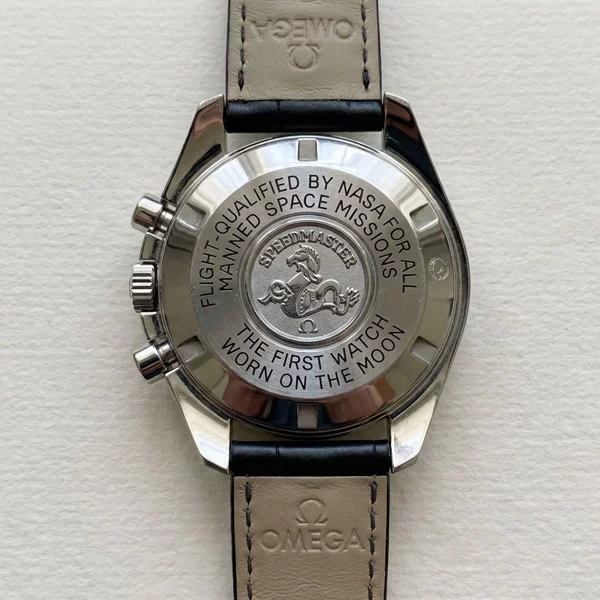
This is not nostalgia dressed up as a product. It is a working chronograph that happens to carry an unrepeatable history on its caseback.
As an Amazon Associate, I earn from qualifying purchases.
Sixty-plus years of production, six Moon landings, and a silhouette that has barely shifted a millimetre. Most watch brands would have redesigned the Omega Speedmaster Professional Moonwatch a decade ago. Omega chose not to. Whether that reads as stubbornness or integrity depends on your expectations, but after extended time on the wrist with the hesalite, leather-strap configuration, our position is clear: the refusal to change is the point.
The reason it has not changed is partly historical fact. In 1964, NASA invited several manufacturers to submit chronographs for qualification testing. The tests were brutal: temperature extremes from minus 18 to plus 93 degrees Celsius, vacuum exposure, vibration, shock loads up to 40 g, and high humidity cycles. The Speedmaster Professional was the only watch to pass every single one of them. It was declared flight-qualified for all manned space missions in 1965. Buzz Aldrin wore it on the lunar surface during Apollo 11 in July 1969. Three years later, during Apollo 13, astronauts used it to time a critical retrorocket burn that brought the crew home after the mission’s near-fatal oxygen tank failure. A watch earns its design freeze when it survives that kind of use record.
This is not nostalgia dressed up as a product. It is a working chronograph that happens to carry an unrepeatable history on its caseback.
Unboxing: Omega Sets the Stage
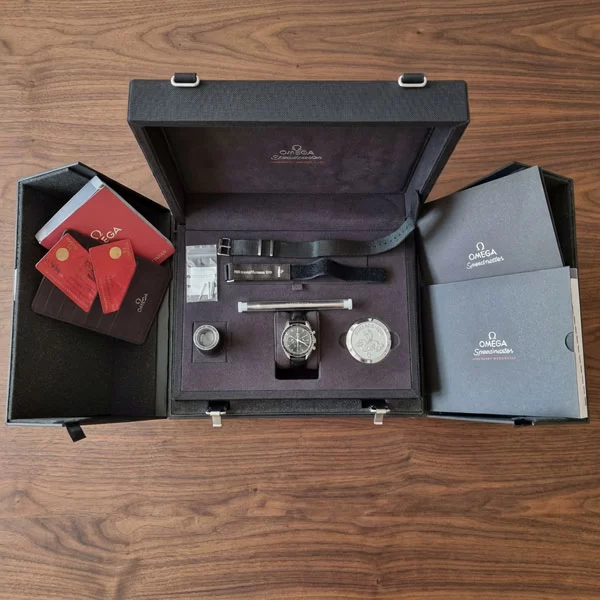
Before the watch even reaches the wrist, this configuration makes its intentions obvious. The presentation box is oversized by any standard, and it is packed deliberately. Inside: the watch on its alligator strap, a black NATO strap, a NASA Velcro strap with printed reference markings, a strap-changing tool, a Speedmaster-branded loupe, and a small stainless-steel paperweight cast in the shape of the caseback. It is an unusual mix of the practical and the ceremonial, and it works better than it sounds on paper.
Omega frames this as a collector’s package, and the framing holds. Picking through the contents takes several minutes. By the time the watch is on the wrist for the first time, you have already handled five or six objects that reinforce the same story. That narrative investment matters, even if you plan to leave the Velcro strap in the box indefinitely.
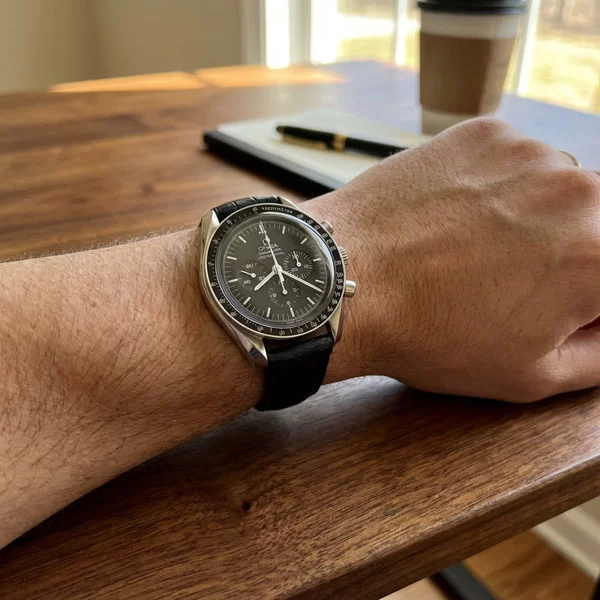
The proportions on the wrist surprise most people who try this watch for the first time. The nominal 42 mm case diameter reads larger than it wears. Curved lyre lugs, a relatively narrow bezel, and a lug-to-lug measurement around 48 mm combine to produce a watch that sits considerably smaller in practice than on paper. We tried it on wrists ranging from 6.5 to 7.5 inches: on every one of them, it landed cleanly, without the overhang or imbalance common to cases this size.
The case height of around 14 mm is worth acknowledging. Under a slim-cut dress shirt cuff, it catches. Under anything relaxed, it disappears entirely within an hour of wear.
Reading the Dial
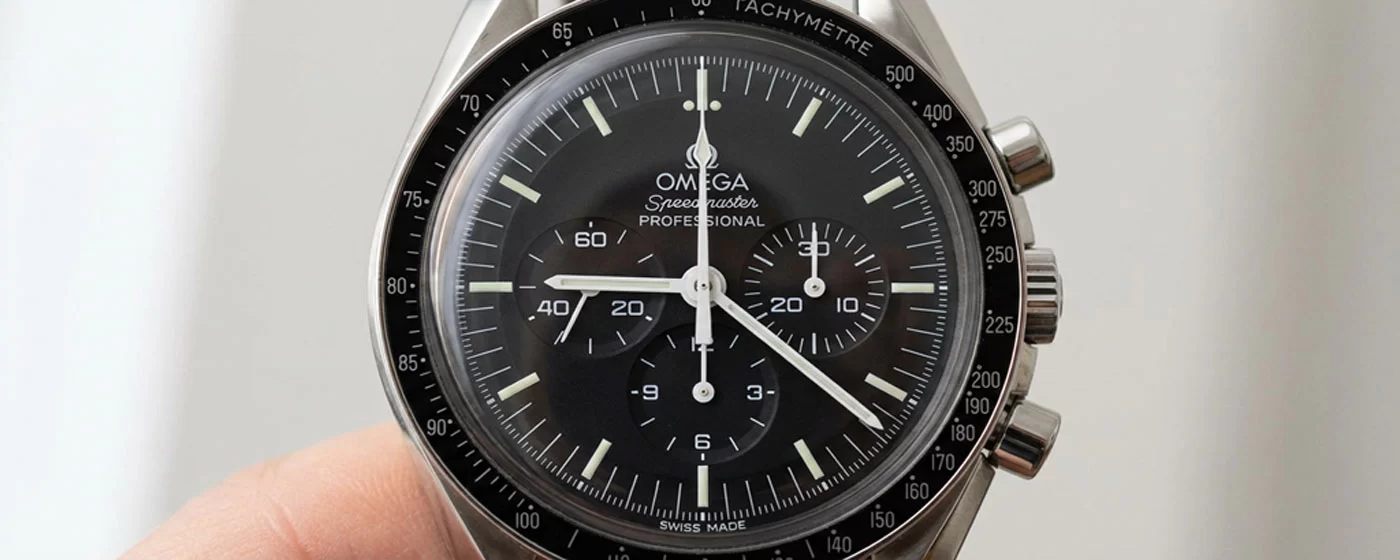
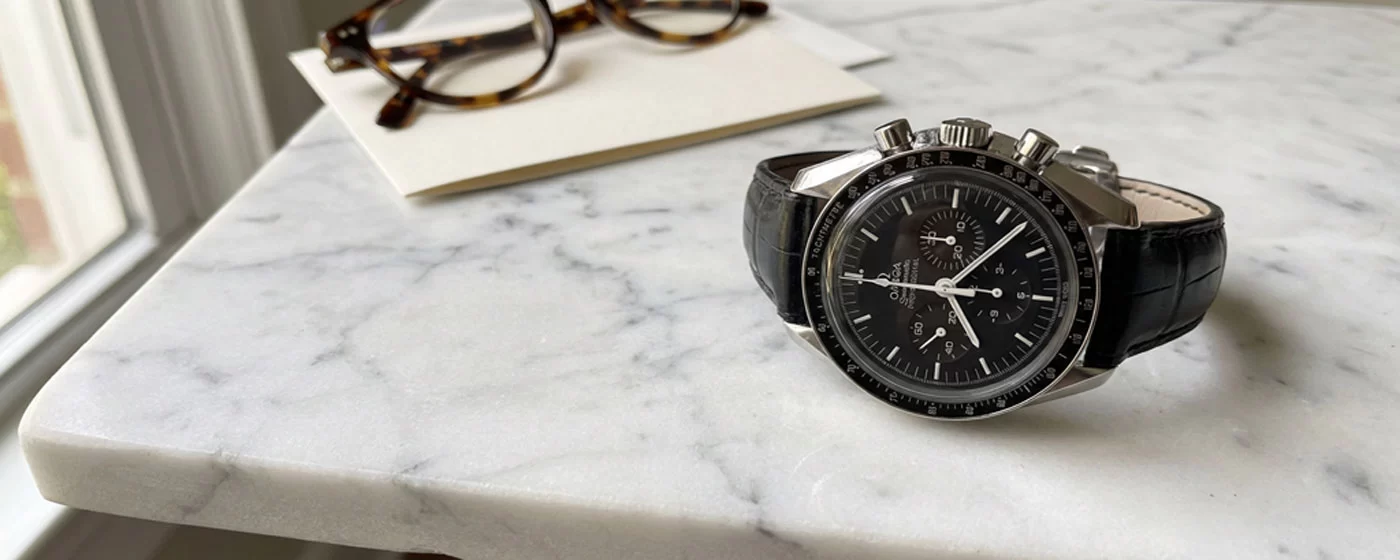
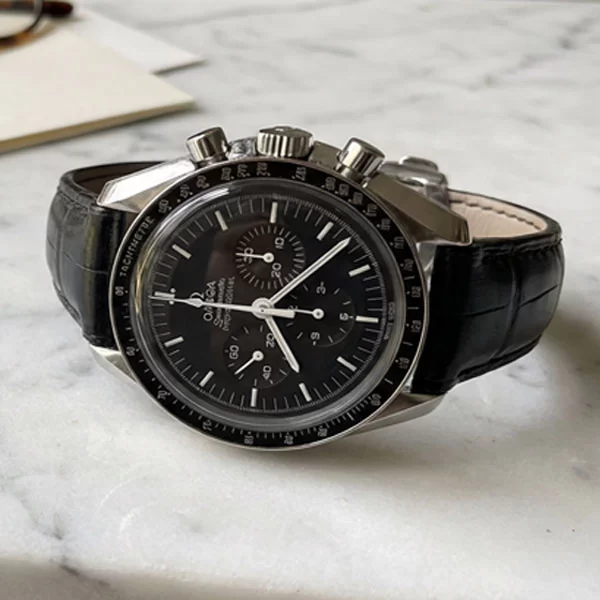
Clarity is the defining quality of the matte black dial, and it is not accidental. The tri-compax layout places the small seconds register at 9, the 30-minute counter at 3, and the 12-hour register at 6. Each sub-dial is slightly recessed, which adds physical depth to an otherwise flat surface. White baton hands and printed markers produce a sharp contrast in almost every light condition. In direct sunlight, the matte finish kills glare entirely. Under poor indoor lighting, the luminous fills on the hour and minute hands are sufficient for a time read at a glance.
There is no date, no rotating inner bezel, no second time zone. For many buyers, that will feel like an omission. For others, it will feel like relief. We are firmly in the second group. This dial layout passed NASA qualification exactly as it was. Nothing about it was designed for the shop window.
Living with Hesalite
The crystal above the dial is Hesalite, the correct term for the acrylic plexiglass Omega has used on the Moonwatch since its NASA days. Compared to sapphire, it reads softer. At oblique angles, it introduces a faint, warm distortion. Some would call it a flaw. In practice, it gives the watch a character that sapphire never quite achieves, a visual warmth that becomes more appealing the longer you spend with it.
The honest side of hesalite: it scratches. Seven days of daily wear produced two fine surface marks on our test watch. Both were polished out in under five minutes with standard crystal polish. This is less a defect and more a maintenance relationship. Buyers who are not prepared for that routine may find it frustrating. Those who accept it as part of ownership report that it stops bothering them quickly.
Movement: The Calibre 1861 in Context
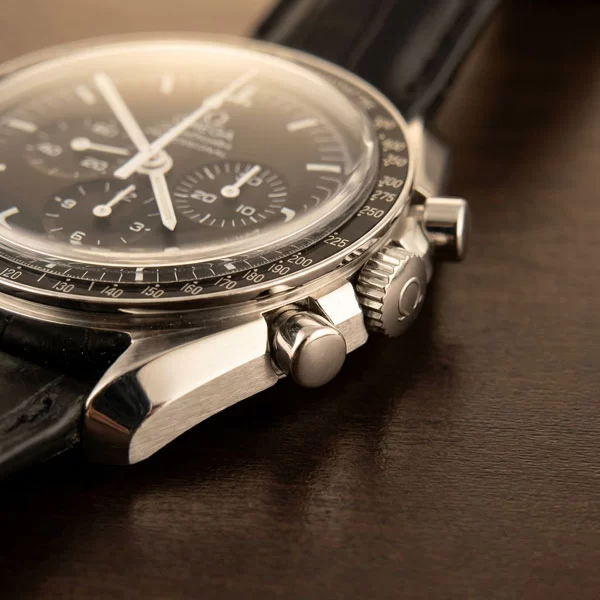
Discussions about the Omega calibre 1861 tend to go one of two ways. Either reviewers frame it as a limitation, or they frame it as a feature. After time with the watch, we think neither framing is quite honest enough.
The 1861 is a manually wound, column-wheel-free chronograph calibre descended from the Lemania 1873. It beats at 21,600 vph, offers approximately 48 hours of power reserve, and carries 18 jewels. It is not COSC-certified. It has no coaxial escapement, no anti-magnetic protection beyond the standard, and no extended power reserve. These are real limitations, and any honest review should say so plainly.
What It Does Well
However, the 1861 is demonstrably reliable, broadly serviceable anywhere in the world, and built on a movement architecture with a longer real-world testing record than virtually anything in its category. When Apollo 13’s oxygen tank exploded in April 1970, the crew had no instruments and no ground support for a critical engine burn. They used the Speedmaster to time it manually. Forty seconds, exactly right. The movement that powers today’s 1861 references is a direct descendant of that calibre. That is not marketing. It is engineering history.
Accuracy in our experience settled to low single-digit seconds per day after an initial period. Pusher engagement is clean and firm. Winding is smooth without any mechanical grittiness. The manual winding routine turns out to be a quiet asset rather than an obstacle — a small daily ritual that creates a genuine connection with the watch. Thirty seconds each morning, count out, eight or ten turns. Simple, but real.
For buyers who weigh technical specifications first, the 1861 will fall short of what the money can buy elsewhere. For buyers who want a movement with a proven track record inside a watch with an earned story, it delivers exactly what it promises.
Strap, Clasp, and the Rest of the Kit
Factory alligator leather straps are not always impressive, but the one supplied here earns its place. It arrived supple, sat flat immediately without any break-in stiffness, and remained comfortable across full days of wear. The push-button deployant clasp closes with two firm, clean clicks and stays put without any play. Adjustability is limited compared to a pin-buckle, though it covers most wrist sizes without adaptation.
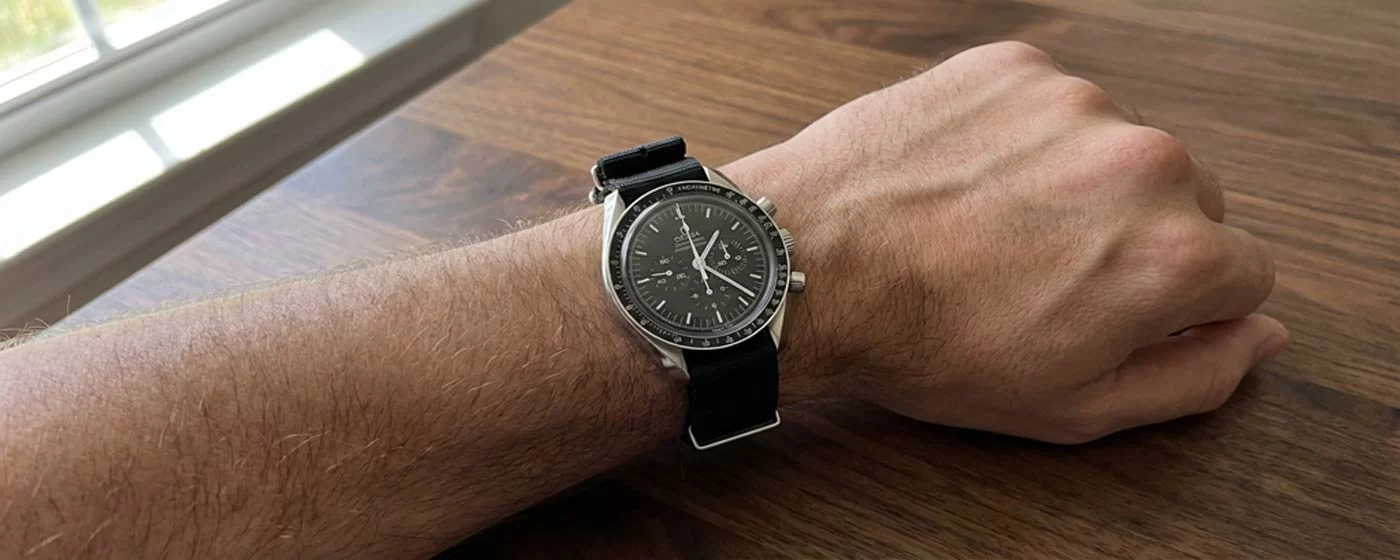
The included NATO strap noticeably changes the character of the watch. On NATO, it becomes lighter, more casual, and easier to live with day-to-day. The included NASA Velcro strap is a period-correct curiosity rather than a practical everyday option, though we wore it for a full day out of genuine interest. It is the same strap type worn by Apollo astronauts over their pressure suit cuffs, which makes it a slightly absurd but entirely irresistible thing to have in the box.
The big box set also includes a loupe, a caseback paperweight, and a strap tool. None of these is necessary. All of them add to the sense that buying this watch is a considered purchase rather than a transaction. For a collector making a deliberate choice, that distinction matters.
What It’s Made Of
| Specification | Detail |
|---|---|
| Reference | 311.33.42.30.01.001 |
| Case material | Stainless steel |
| Case diameter | 42.0 mm |
| Case thickness | ~14.3 mm |
| Lug-to-lug | ~48 mm |
| Lug width | 20 mm |
| Crystal | Hesalite (acrylic / plexiglass) |
| Caseback | Solid stainless steel, engraved |
| Dial | Matte black, tri-compax chronograph layout |
| Bezel | Fixed black aluminium tachymeter insert |
| Movement | Omega calibre 1861, manually wound |
| Power reserve | ~48 hours |
| Frequency | 21,600 vph (3 Hz) |
| Jewels | 18 |
| Water resistance | 50 m / 5 bar |
| Strap | Black alligator leather, 20 mm |
| Clasp | Stainless steel push-button deployant |
| Country of manufacture | Switzerland |
What It’s Up Against
At this price tier, the Speedmaster Professional Moonwatch competes against a mix of automatic and manually wound steel chronographs, most of which offer more contemporary movement specifications. The table below maps the most relevant alternatives and where the trade-offs actually sit.
| Watch | Reference | Movement | Case | Crystal | Water resistance | Key trade-off vs. Speedmaster | Price Range |
|---|---|---|---|---|---|---|---|
| Omega Speedmaster Professional Moonwatch (reviewed) | 311.33.42.30.01.001 | Manual winding, cal. 1861 | 42 mm steel | Hesalite | 50 m | — | |
| Zenith Chronomaster Original | 03.3200.3600/69.M3200 | Automatic, El Primero 3600, 5 Hz | 38 mm steel | Sapphire | 50 m | High-beat automatic, date, display back; less focused narrative | About the same as Omega |
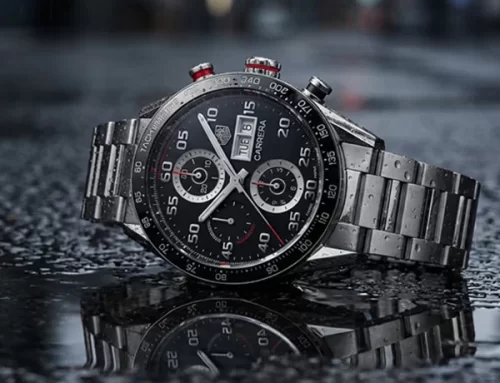
| TAG Heuer Carrera Chronograph | CBN2A10.FC6492 | Automatic, Heuer 02, 80 h power reserve | 42 mm steel | Sapphire | 100 m | Stronger technical specs; design identity less singular | |
| IWC Pilot’s Watch Chronograph | IW388101 | Automatic, in-house | 41 mm steel | Sapphire | 100 m | Aviation-first aesthetic; bulkier profile, no space narrative | About the same as Omega |
The Right Buyer for This Watch

Clarity on this question matters more than with most watches. The Hesalite, leather-strap Speedmaster Professional is not a universal recommendation. For a buyer whose primary criteria are modern movement certifications, low-maintenance water resistance, and scratch-proof optics, better options exist at a comparable price. The watch does not hide these trade-offs, and neither should a review.
By contrast, a buyer who wants a manually wound tri-compax chronograph with direct visual lineage to the NASA-era originals, a meaningful strap collection out of the box, and one of the most recognised dial layouts in the history of the medium will find very few alternatives that do what this watch does as convincingly. It is not a watch for everyone. It is, however, exactly the right watch for a specific type of enthusiast, and that type of enthusiast will not be disappointed.
Daily winders, strap rotators, people drawn to the space programme story, buyers who care about what a watch represents as much as what it measures. These are the people who buy this watch and keep it for a decade.
Final Verdict
A watch that has been in continuous production for over sixty years and still generates genuine conversation about whether it is worth buying has clearly done something right. The Omega Speedmaster Professional Moonwatch in Hesalite, leather-strap form, is not the most technically advanced chronograph at its price. It is not the easiest to maintain. It does not offer the movement specifications that its own current production successor delivers.
What it offers instead is harder to manufacture: authenticity, an unbroken design lineage, and a story that belongs to it alone. In a market full of watches that claim heritage, this one simply has it. For the right buyer, that is worth considerably more than a longer power reserve.